REVIEW · MUMBAI
Sightseeing tour with Elephanta cave tour
Book on Viator →Operated by Mystical Mumbai · Bookable on Viator
Elephanta is Mumbai’s fastest time machine. This tour pairs a ferry ride to the UNESCO Elephanta Caves with a guided loop through classic South Mumbai sights, so you get temples and architecture in one long day. I love that the guide stays with you start to finish, and I love the pacing—enough time to look, not so much that you feel chased.
The main catch is physical: you should plan for a climb of about 120 steps at Elephanta, plus the island can have wild monkeys. Food and drinks aren’t included, so you’ll want to budget for snacks and extra water if you get thirsty.
In This Review
- Key things to know before you go
- Elephanta Caves: how the day starts (and why it matters)
- Ferry ride + island reality: steps, monkeys, and photo timing
- Elephanta Caves: what you’ll actually be looking at
- South Mumbai after the caves: why these stops work together
- Gateway of India and Taj Mahal Palace: the postcard start
- Chhatrapati Shivaji Maharaj Terminus (CSMT): train-station drama
- Mumbai University Library + Rajabai Clock Tower: British-era schooling and scale
- Dhobi Ghat and High Court: where Mumbai shows the working side
- Mani Bhavan Gandhi Museum: the story anchor
- Views that earn their time: Kamala Nehru Park, Marine Drive, fountains, libraries
- Timing: what your 6–7 hours really feel like
- Price and value: is $115.75 worth it?
- Who should book, and who should think twice
- Should you book this Elephanta and South Mumbai tour?
- FAQ
- How long is the Elephanta Caves sightseeing tour?
- What’s included in the price?
- Which stops have admission fees included?
- Do I get a guide during the entire experience?
- Is there a lot of walking or stairs at Elephanta?
- What happens if the weather is poor?
- Is this tour private or shared?
Key things to know before you go
- Elephanta Caves with admission included so you can focus on the sites, not ticket logistics
- Hotel pickup and drop-off plus ferry tickets built into the day
- A guide with you the whole time, including at least one stop-light on your behalf when you need direction
- Ferry ride is part of the show, not just transport
- Quick photo stops in South Mumbai mean you’ll see a lot, but not linger everywhere
- Plan for stairs and monkeys so the experience stays fun, not stressful
Elephanta Caves: how the day starts (and why it matters)
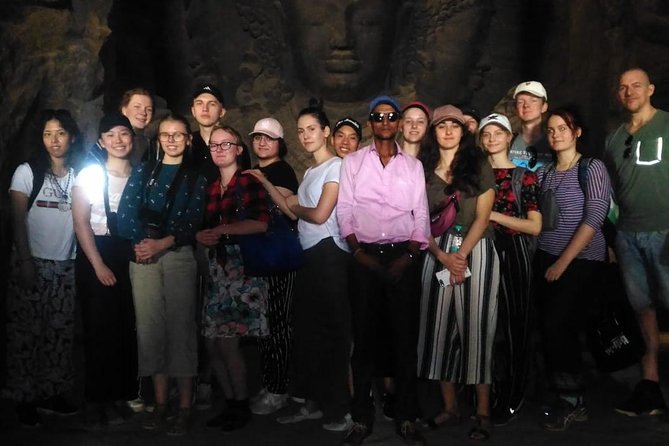
Most Mumbai sightseeing tours have a hard choice: either you spend your time in the city, or you spend it offshore. This one solves that by starting with the Elephanta Caves, a UNESCO World Heritage site just off the coast. You’re not only traveling outward—you’re switching worlds. One side of the day is rock-cut temples and sculpture. The other side is South Mumbai’s grand monuments and colonial-era details.
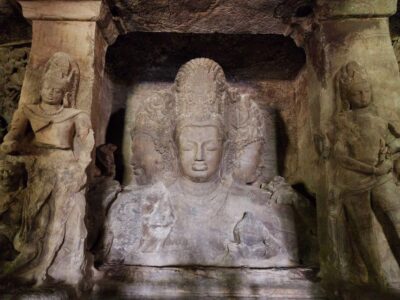
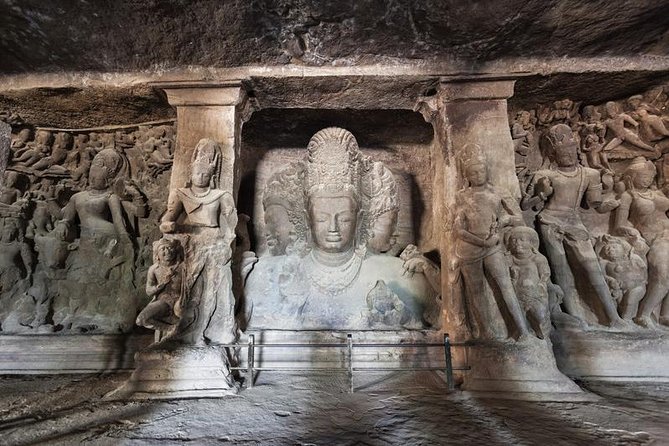
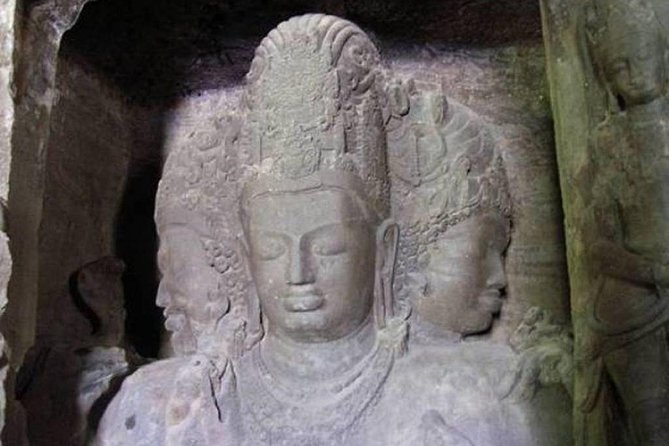
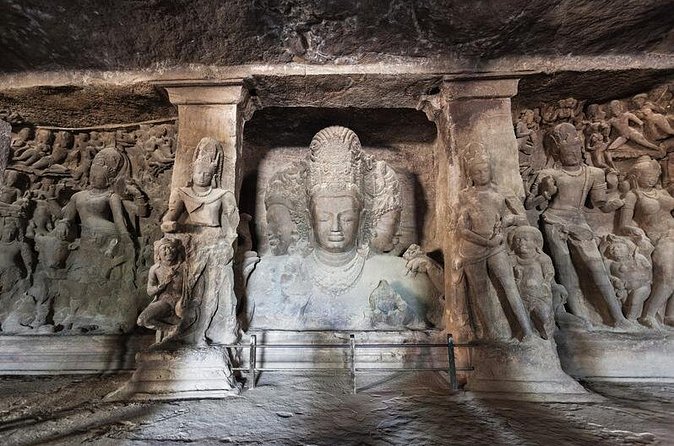
After a ferry ride to Elephanta Island, you get guided time in the caves. The outer caves were used as a place of Hindu worship until Portuguese rule was established, while the interior caves are smaller and feel more intimate once you get deeper inside. That contrast is a big part of why the caves are worth the effort: the site isn’t one single “wow moment,” it’s a sequence.
You’ll be glad there’s a guide for this part. When you’re standing in front of carved panels and knowing which direction to look, someone who can point out what you’re seeing makes a huge difference in satisfaction. In past departures, the tour’s guides—such as Anthony and Dev—have been praised for keeping things safe and organized, including helping with photos.
You can also read our reviews of more tours and experiences in Mumbai.



Ferry ride + island reality: steps, monkeys, and photo timing
The ferry ride out is more than a transfer. It sets expectations for the day: sea air, open views, and that feeling you’re leaving Mumbai behind for a bit. It also helps because the caves themselves take time—about 5 hours total of cave time is built in—so you don’t want your day derailed early.
Here’s the practical part: the island can involve a climb of about 120 steps to reach the caves. If you don’t love stairs, plan your pace. Take it slow on the way up, and use your guide’s direction on where to stop so you can catch your breath without feeling rushed.
Then there’s the monkey factor. Elephanta Island has wild monkeys, and they’re not just background characters—they can be bold when people have snacks or shiny things. Keep your belongings close, avoid reaching into bags in view of monkeys, and don’t try to feed anything. It’s one of those situations where a little common sense protects the whole mood.
If you care about photos, you’re in luck. Guides have helped guests get good shots and keep everyone safe without turning it into a frantic photo sprint. Just keep in mind that the cave setting can have shade and uneven footing, so comfortable shoes matter more than perfect fashion.
Elephanta Caves: what you’ll actually be looking at
Inside the caves, you’re looking at a layered religious story told in stone. The outer areas were linked to Hindu worship before Portuguese rule, and as you move farther in, the spaces shift—smaller, more enclosed, and easier to feel the change in atmosphere. This is the kind of site where your first look sets the hook, but your second look makes it stick.
You won’t be wandering alone. The tour includes a guide and you’re moving as a group, which reduces the chance you miss key areas. It also keeps the time realistic: caves are slow by nature. Even if you’re not a deep researcher, you’ll want a moment to stand back, then get closer, then re-check the details.
One more thing: because the tour is subject to favorable weather, the cave portion can be affected indirectly. If conditions are rough, you might get different timing or a different plan for the day. The good news is the operator provides an option of an alternative date, tour, or a full refund if cancellation happens due to poor weather.
South Mumbai after the caves: why these stops work together

Once you return to shore, the tour becomes a guided whirlwind through South Mumbai’s big-name sights. Many stops are short—think 10 to 20 minutes each—so this isn’t the day for a slow, museum-style approach. It is the day for seeing a lot, understanding what you’re looking at, and getting oriented fast.
The route is also balanced: you get landmarks tied to empire and royal visits, major transport architecture, and working-city scenes like Dhobi Ghat. You’re not stuck in only one theme, and that keeps the day from getting stale.
Gateway of India and Taj Mahal Palace: the postcard start
You’ll make a quick stop at the Gateway of India, Mumbai’s famous monument built to welcome King George V and Queen Mary into India. It’s short, but it sets tone right away: big ceremonial stone in a city that never stops moving.
Next is the Taj Mahal Palace Hotel in Colaba. Even when you’re not going inside, the exterior matters. It’s a heritage five-star property in Saracenic Revival style, and that mix of influences is a big theme across Mumbai’s colonial-era architecture. This stop is mostly for context and photos.




Chhatrapati Shivaji Maharaj Terminus (CSMT): train-station drama
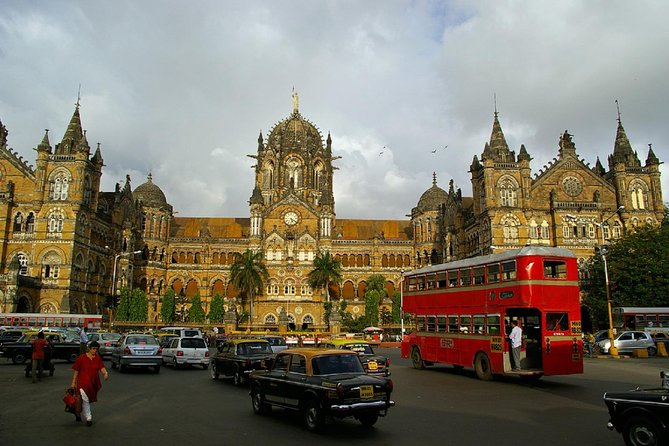
Then comes Chhatrapati Shivaji Maharaj Terminus, a station designed by Frederick William Stevens and built in Victorian Italianate Gothic Revival. The intention was to create a revival style with links to Indian Gothic (classical era). Even if you’re not a train person, this one is worth your attention because it looks like a monument first and transportation hub second.
The stop lasts around 20 minutes, which is usually enough to spot the main features and frame a good photo from outside.
Mumbai University Library + Rajabai Clock Tower: British-era schooling and scale
You’ll also see the University of Mumbai Library, a British heritage building built in 1857. It’s the kind of architecture you might miss if you’re not looking for it, so the guide’s pointing is a real value here.
Right after, the Rajabai Clock Tower appears as part of the Victorian and Art Deco Ensemble of Mumbai, added to the World Heritage list in 2018. Even a short look helps you understand why Mumbai’s “old” buildings are still part of daily life.
Dhobi Ghat and High Court: where Mumbai shows the working side
Not every stop is a polished monument. Dhobi Ghat (the open-air laundry) is one of those scenes that hits differently. It’s described as the largest open-air laundry, and clothes are washed in full view of the public. Even if you only take a few minutes, the reality of how the city functions is right there.
Then you’ll also pass Bombay High Court, one of the oldest high courts in India. It’s not a long stop, but it fits the story: Mumbai isn’t only about sightseeing—it’s about institutions and daily power structures.
This part of the tour is good for people who like authenticity over perfectly staged views. It’s not “touristy” in the same way as Gateway, and that keeps the day feeling real.
Mani Bhavan Gandhi Museum: the story anchor
After the city scenes, the tour includes Mani Bhavan Gandhi Museum. This is a museum and historic building dedicated to Gandhi, and it was the focal point of his political activities in Mumbai between 1917 and 1934.
The admission ticket for this stop is included, which is a smart move because museums are where a day can get expensive fast if you’re paying add-ons one by one. The time here is around 20 minutes, which means you’ll see the core ideas without needing a full half-day.
If you want a quieter moment to balance the big architecture stops, this is your best bet. It adds meaning, not just scenery.
Views that earn their time: Kamala Nehru Park, Marine Drive, fountains, libraries
The tour keeps moving through recognizable skyline spots and public landmarks. At Kamala Nehru Park, you get a skyline view and the famous old woman’s shoe. It’s one of those local landmarks that’s easy to miss if you’re not told where to look.
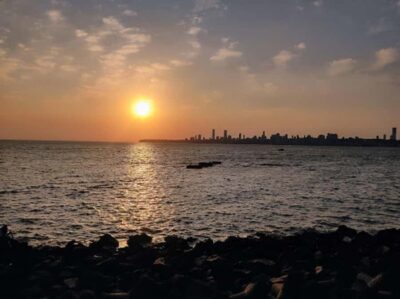
You’ll also drive around Marine Drive, often called the Queens Necklace. You might not be getting a long walk here, but the views from the road give you that signature line of light and curve people talk about.
Then the route includes Hutatma Chowk and Flora Fountain (lora Fountain), described as an ornamentally and exquisitely sculpted architectural heritage monument. This is a quick stop, but it’s exactly the kind of detail-rich sight that feels like a reward for doing all the earlier legs.
Finally, you’ll see the Chhatrapati Shivaji Maharaj Vastu Sangrahalaya (Prince of Wales Museum), established in the early 20th century. It’s a strong cultural stop in a route that’s otherwise heavy on street-level monuments.
And there’s also the David Sassoon Library, a heritage structure in Mumbai. The inspiration for creating a central-city library is credited to Albert Sassoon, so there’s a built-in story even if you just take in the exterior.
Timing: what your 6–7 hours really feel like

The tour runs about 6 to 7 hours, and that makes a difference in your expectations. This is not a “sit and sip tea” day. It’s a structured day with a long first leg at Elephanta and then a series of short city stops.
Because many South Mumbai stops are around 10 minutes, you should treat the city portion like a guided sampler. You’ll come away with names, context, and a clearer sense of where things are. Then, if you want to return later, you’ll know what to target.
Also note: the tour includes a mini train and tolls. The listing doesn’t spell out exactly where the mini train segment happens, but practically, it’s there to help the route move smoothly. Think of it as time-saving rather than a major attraction by itself.
Price and value: is $115.75 worth it?
At $115.75 per person, this tour isn’t the cheapest way to see Mumbai. But it also isn’t priced like a bare-bones city walk.
Here’s the value math from what’s included: hotel pickup and drop-off, ferry cost, a guide and driver for the day, and bottled water. On top of that, Elephanta Caves admission is included, and Mani Bhavan Gandhi Museum admission is included too. Several big-name stops in South Mumbai are listed as free, including Gateway of India, Taj Mahal Palace area views, CSMT, Rajabai Clock Tower, and more.
So you’re paying for transportation + guide time + the two paid admissions that matter most. If you tried to self-plan it, you’d spend time coordinating ferry logistics, adding tickets, and figuring out the exact order to minimize backtracking. The guide keeps the day coherent.
If you’re a solo traveler, this kind of organized structure can be a big relief. If you’re a group, the tour also mentions group discounts, which can make it feel even better.
Who should book, and who should think twice
This tour is best for you if you want a one-day plan that covers both the offshore UNESCO caves and the major South Mumbai landmarks. It’s also a good fit if you appreciate clear guidance at complex sites like the caves, where knowing what you’re looking at changes everything.
You should think twice if you strongly dislike stairs. Elephanta involves a climb of about 120 steps, and the island can have wild monkeys, so it’s better if you can handle a few real-world surprises.
Also, if you want long, slow museum time or lots of shopping, this isn’t your style. Most city stops are brief, so you’re collecting impressions and context rather than lingering for hours.
One bonus detail: this is listed as a private tour/activity, meaning only your group participates. That can help with pace and comfort, especially on a day that includes both stairs and a packed sightseeing route.
Should you book this Elephanta and South Mumbai tour?
I’d recommend booking if you want a structured day where Elephanta Caves are the anchor, then South Mumbai sights fill in the context. The included ferry + transfers + guide makes it feel efficient, and the guided approach helps you get more out of each stop than a quick self-guided loop.
Skip it if stairs are a deal-breaker for you, or if you’d rather avoid any animal surprises on a coastal island. And if your top priority is food, make sure you’re planning on buying your own snacks and drinks since food and drinks aren’t included.
If you’re ready for a full day with two different sides of Mumbai—temples and monuments—this is a solid, practical choice.
FAQ
How long is the Elephanta Caves sightseeing tour?
The tour is approximately 6 to 7 hours.
What’s included in the price?
The price includes hotel pickup and drop-off, ferry cost, a mini train and tolls, bottled water, and a guide and driver. Elephanta Caves admission is included, and Mani Bhavan Gandhi Museum admission is included as well.
Which stops have admission fees included?
Elephanta Caves includes an admission ticket, and Mani Bhavan Gandhi Museum includes an admission ticket. Many other sight stops on the route are listed as free.
Do I get a guide during the entire experience?
Yes. A guide greets you at your hotel and stays with you throughout the tour.
Is there a lot of walking or stairs at Elephanta?
There is a climb to reach the caves, and the experience can involve about 120 steps. Comfortable walking shoes help.
What happens if the weather is poor?
If the tour is canceled due to poor weather, you’ll be offered an alternative date, an alternative tour, or a full refund.
Is this tour private or shared?
It’s listed as a private tour/activity, so only your group participates.